

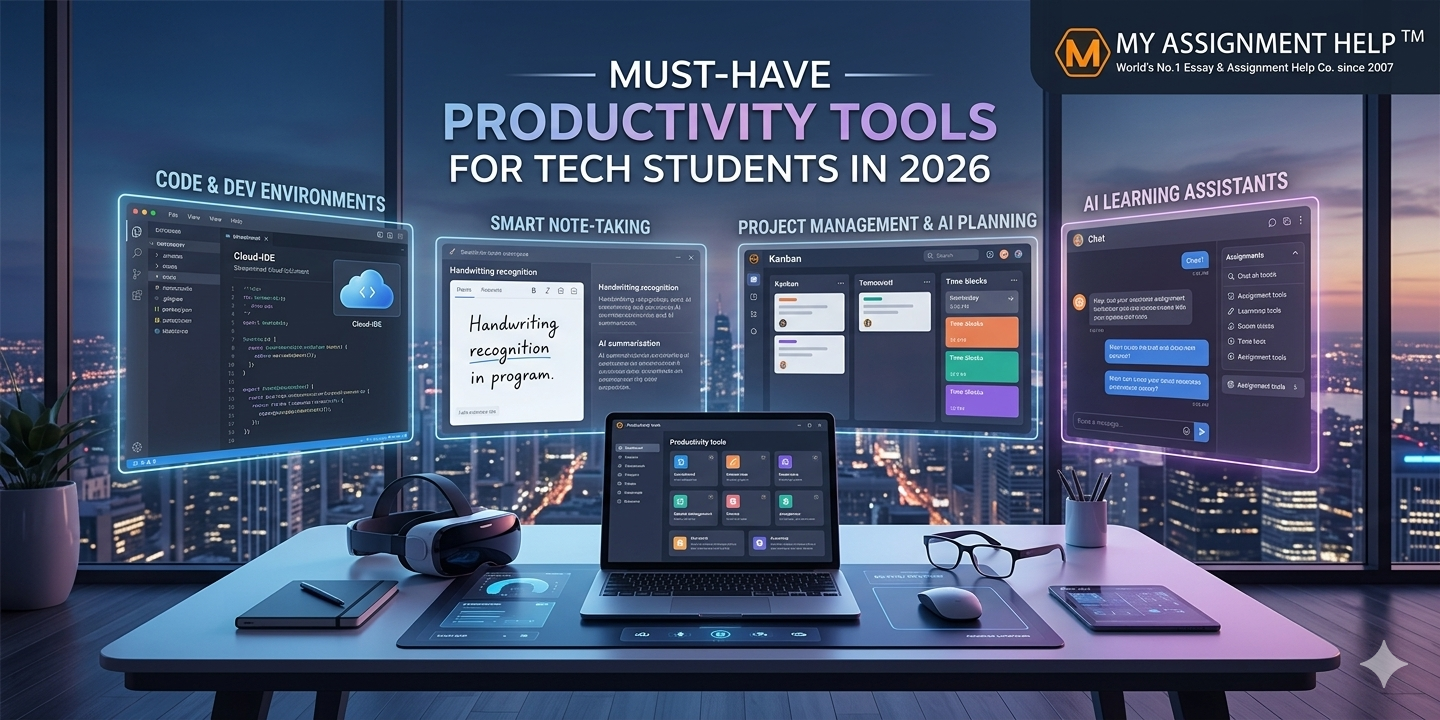
The academic landscape for tech students in 2026 has shifted from simple coding and note-taking to managing complex, multi-modal AI workflows. In the heart of Silicon Valley and across premier US tech hubs, the “Study Stack” is no longer just about having a laptop; it’s about an integrated ecosystem of tools that automate the mundane, allowing students to focus on high-level architecture and creative problem-solving.
As we navigate this “Intelligence Age,” the pressure on Computer Science and Engineering students has reached an all-time high. Balancing leetcode grinding, open-source contributions, and a full credit load requires more than just grit—it requires a tactical advantage.
The Evolution of the Tech Student Workflow
In 2026, the barrier between “learning” and “doing” has thinned. Students are expected to deploy microservices while studying for midterms. However, when the technical overhead becomes overwhelming or deadlines for non-core subjects loom, many students look for strategic ways to manage their time. While optimizing your digital stack is essential, sometimes the most productive move is knowing when to delegate. If you find yourself swamped with general education requirements that stall your progress in your major, paying someone to do your assignment can provide the breathing room needed to master complex React frameworks or Neural Network optimization.
1. The Integrated Development Environment (IDE) evolved: Cursor & GitHub Copilot X
By 2026, the standard IDE has been replaced by “AI-Native” editors. Cursor has become the gold standard in Silicon Valley. Unlike traditional editors where AI is a plugin, Cursor is built around a large language model that understands your entire codebase.
- Why it’s a must-have: It allows for “Natural Language Refactoring.” You can highlight a block of legacy C++ and simply type “convert this to a Rust memory-safe implementation,” and it executes the change instantly.
- Data Point: According to a 2025 Stack Overflow Developer Survey, students using AI-integrated IDEs reported a 45% reduction in time spent on syntax-related debugging.
2. Neural Note-Taking: Notion + Obsidian (The Hybrid Approach)
The “Second Brain” methodology has matured. Tech students are now using a hybrid system: Notion for project management and Obsidion for local-first, encrypted knowledge mapping.
- Notion: Acts as the command center for group projects and internship applications.
- Obsidian: Used for deep technical notes. With the “Canvas” feature, students can visually map out how a backend database interacts with a frontend UI, creating a permanent, searchable mental model of their degree.
3. High-Performance Research: Perplexity AI & Consensus
Gone are the days of scrolling through pages of blue links. For technical research, Silicon Valley students rely on Perplexity AI for real-time citations and Consensus for academic rigor.
- The Benefit: When writing a paper on the ethics of Quantum Computing, Consensus searches through over 200 million peer-reviewed papers to provide evidence-based answers, ensuring your citations are “hallucination-free.”
4. Managing the Load: Strategic Delegation
Even with the best tools, the sheer volume of deliverables in a tech degree can lead to burnout. Professional assignment writing services have become a staple for students who need to prioritize their “Deep Work.” By offloading repetitive technical writing or formatting tasks to experts, students can focus on the high-stakes coding projects that actually build their portfolios.
See also: The Role of Big Data in Business Intelligence
Key Takeaways for 2026
- AI-Native Tools: Switch from standard editors to AI-integrated IDEs like Cursor to speed up the learning curve.
- Local-First Knowledge: Use Obsidian to build a “Second Brain” that you own, even after you graduate and lose your school accounts.
- Verified Research: Use Consensus and Perplexity to ensure technical papers are backed by peer-reviewed data.
- Strategic Outsourcing: Use professional services to manage secondary tasks, keeping your focus on core technical competencies.
Frequently Asked Questions (FAQ)
Q: Is using AI in my IDE considered academic dishonesty?
A: In 2026, most US tech programs encourage the use of AI tools as long as the student can explain the logic and “manual” implementation of the code. Always check your specific course syllabus for “AI-allowable” policies.
Q: Why use Obsidian over a simple Google Doc?
A: Obsidian uses Markdown files stored locally on your machine. This allows for “backlinking,” where ideas are connected in a graph rather than a linear list, which is how technical concepts actually work.
Q: How do I know which assignment services are reliable?
A: Look for services that prioritize EEAT (Expertise, Authoritativeness, and Trustworthiness). Ensure they provide original reports and have a history of working with STEM-specific requirements.
About the Author: Sarah Jenkins
Content Strategist & Senior Academic Consultant at MyAssignmentHelp
Sarah Jenkins has over a decade of experience in the EdTech sector, specifically focusing on the intersection of AI and student productivity. Based in the San Francisco Bay Area, she tracks emerging software trends to help students optimize their workflows. When she’s not analyzing Google Search Console trends for academic keywords, she’s mentoring CS undergraduates on building their digital portfolios.
References & Data Sources:
- The 2025 Developer Productivity Report: Analyzing the impact of AI on junior engineers.
- Journal of Educational Technology (Vol. 14): The shift toward “Second Brain” methodologies in STEM higher education.
- Silicon Valley Tech Census 2026: Surveying tool-adoption rates among Stanford and UC Berkeley engineering students.


 3 Best Assignment Help Services In Singapore For Fast Assignment Delivery