

Starting a journey into the world of programming is much like learning a new language while simultaneously trying to solve a complex architectural puzzle. In Australia, the demand for tech talent is soaring, with the National Skills Commission identifying software programmers as one of the fastest-growing occupations over the next five years.
However, the path from “Hello World” to building functional applications is rarely a straight line. Many aspiring developers in Sydney, Melbourne, and beyond find themselves hitting the same digital brick walls. If you are feeling overwhelmed, you aren’t alone. Understanding these roadblocks is the first step toward clearing them.
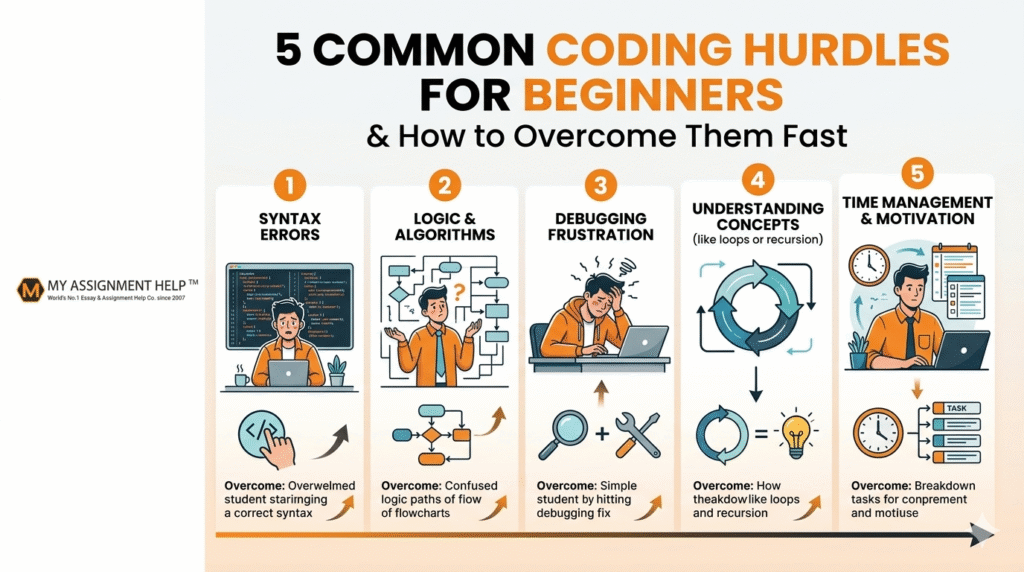
1. The Syntax Struggle: Speaking the Machine’s Language
The first hurdle most beginners face is syntax—the strict rules that govern how code must be written. Unlike human conversation, where a slight slip of the tongue is overlooked, a single missing semicolon in C++ or an incorrect indentation in Python can cause an entire program to crash.
This “syntax anxiety” often leads to hours of frustration. To overcome this fast, stop trying to memorise every command. Instead, focus on the logic. Use modern Code Editors like VS Code that offer “linting” (real-time error highlighting). If you find yourself stuck on a complex project and the errors won’t stop, it’s often wise to seek professional programming help to understand where your logic is deviating from the required syntax. Seeing a corrected version of your own work is one of the fastest ways to learn.
2. The Logic Gap: Thinking Like a Programmer
Many beginners can read code but struggle to write it from scratch. This is known as the “Logic Gap.” You know what you want the program to do, but you can’t translate that intent into a sequence of steps.
In the Australian academic circuit, computational thinking is now a core part of the curriculum. To bridge this gap, step away from the keyboard. Use pseudocode—writing out the logic in plain English—before you type a single line. Break the problem into the smallest possible pieces. If you’re struggling with a heavy workload, you can always ask an expert to help me with my assignment to see how professional developers structure their logic flow.
See also: From Store-Bought to Homemade: Why Indian Homes Are Choosing Breadmakers
3. Debugging Fatigue
Debugging is 90% of programming. For a beginner, spending four hours looking for a bug only to find a typo is soul-crushing. According to a study by the University of Cambridge, programmers spend an average of 50% of their time debugging, costing the global economy billions annually.
How to overcome it fast:
- The Rubber Duck Method: Explain your code line-by-line to an inanimate object (or a friend).
- Use Print Statements: Insert print() or console.log() at every step to see exactly where the data goes wrong.
- Take a Break: Studies in cognitive science suggest that “incubation periods” allow the brain to solve problems subconsciously.
4. Overwhelming Choice (Analysis Paralysis)
Should you learn Python, JavaScript, Ruby, or Rust? The sheer volume of frameworks and languages can lead to “tutorial hell,” where you jump from one course to another without ever building anything.
The Australian tech market currently has a high demand for Cloud Computing and AI integration. To overcome analysis paralysis, pick one language based on your goal (e.g., JavaScript for web, Python for data science) and stick with it for at least six months. Depth is more valuable than breadth in the early stages.
5. Impo ster Syndrome
The “I’m not smart enough for this” feeling is the biggest reason beginners quit. Programming is not about being a “math genius”; it is about persistence. Even senior developers at companies like Atlassian or Canva Google basic syntax every single day.
Key Takeaways for Fast Progress:
- Focus on Fundamentals: Master loops, variables, and data structures before jumping into AI or Game Dev.
- Build Projects: A messy, working app is better than ten finished tutorials.
- Seek Mentorship: Don’t struggle in isolation; use academic resources and forums.
- Practice Daily: 30 minutes every day is better than a 5-hour marathon once a week.
FAQ Section
Q1: How long does it take to get comfortable with coding?
A: Most beginners start feeling “competent” after 3-6 months of consistent daily practice. However, mastery is a lifelong journey.
Q2: Is math necessary for programming?
A: For most web and app development, basic algebra is sufficient. Advanced math is generally only required for Data Science, Game Engines, or Cryptography.
Q3: What is the best language for beginners in Australia?
A: Python is highly recommended due to its readable syntax and its prevalence in Australian data and research sectors. JavaScript is the go-to for web development.
Q4: How do I stop forgetting what I learn?
A: Use the “Learn-Apply-Teach” model. Learn a concept, apply it in a project immediately, and then try to explain it to someone else.
About the Author: Sarah Jenkins
Sarah Jenkins is a Senior Academic Consultant at MyAssignmentHelp. With over a decade of experience in Software Engineering and a Master’s Degree from the University of Melbourne, Sarah specialises in helping Australian students bridge the gap between theoretical computer science and practical coding application. She is a regular contributor to tech education forums and a mentor for women in STEM.
Data Sources & References:
- National Skills Commission (Australia) – Occupations in Demand Report 2023.
- University of Cambridge Study on the Economic Impact of Debugging (2013).
- Stack Overflow Developer Survey 2023 – Learning to Code Trends.
- Cognitive Research: Principles and Implications – The role of ‘Incubation’ in Problem Solving.


 Why Learning ITIL® 5 Service Is Essential for Today’s ITSM Roles